8W Science - the Iodine Clock Reaction
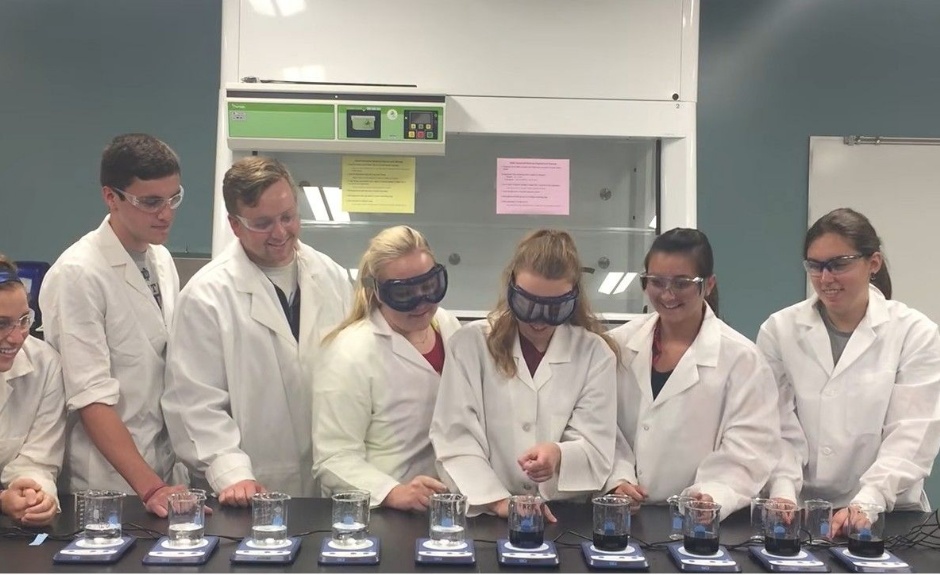
Since 8W finished their exams, I have been showing the boys a variety of visually impressive experiments which we then discuss, to see what principles of Science are involved, and what they have learned.
One of these experiments is called the ‘Iodine Clock Reaction’ which was discovered by Hans Heinrich Landolt in 1886 and is a classical demonstration experiment that displays chemical kinetics in action. Two solutions are mixed, and at first there is no visible reaction, but after a short time delay, the liquid suddenly turns dark blue-black due to the formation of a triiodide-starch complex. Depending on the amount of one of the chemicals present (the thiosulphate), the sudden turning of the white liquid to blue-black can be controlled.
We set our experiment up with different concentrations of the thiosulphate solution roughly in the form of a clock-face and the idea was to see 1 change the quickest, and 12 the slowest. The experiment worked perfectly (bar a couple of early additions) and presented the boys with the opportunity to discuss the principles of chemical kinetics, which - as usual - they did with aplomb.
Well done, 8W!
If you'd like to see the reaction set to music with stunning effect, do watch the short clip at this link: Iodine Clock Reaction Timed to Tchaikovsky's Russian Dance from The Nutcracker.
Bryony Carpenter
Science Teacher