Here we go, here we go, here we go…

The thing that I’m about to suggest tarnishes the gilt of the World Cup experience did, at least, plonk some nostalgia under my nose via my phone the other day.
Just as with my half penny piece recently, I found myself lingering over a childhood memory. In this case, an old clip of a World Cup match. The picture quality was not exactly what we would now call high definition; the colours were slightly washed, the camera angles limited and the crowd was a blur of waving arms and indistinct noise. And of course, within a few moments, I was quite transported.
It was, I think, Mexico in 1970. Pelé rising above defenders who seemed rooted to the turf, to head Brazil into the lead in the final. The coverage was straight forward: one moment and one shared intake of breath, followed by that eruption of noise. No VAR lines calibrated to the millimetre, no 27 different replays before the restart. A goal, and the immediate reaction.
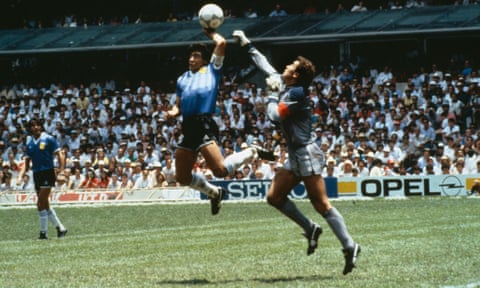
Next in my scroll came another: Mexico again, though this time 1986. Diego Maradona weaving his way through the England defence, the ball seeming somehow gripped to his foot, as if by that other mainstay of 1980s TV nostalgia – Blue Peter’s famous ‘sticky backed plastic’. He then finishes with a calmness that belied the slightly chaotic defending that had preceded it. A few minutes earlier, of course, had come ‘the other goal’; the Hand of God that has been debated ever since! That too felt part of a sports language (flaws, errors, rather messy) now largely faded under the glare of increasingly demanded perfectitude and technology-driven accuracy.
These tournaments of the 70s and 80s belonged to a more ‘contained’ world. There were fewer teams, fewer matches, and, importantly, more space between them. As a young boy, with Panini albums readily filled, one waited. One anticipated. The television schedules were pored over in advance; the matches discussed the following day in tones close to sacred reverence. Highlights were, quite literally, highlights.

This forthcoming World Cup offers something of a contrast. Spread across three nations and encompassing an extraordinary 104 matches, it represents something entirely different in scale. It is, by any measure, the biggest there has ever been. Football, no longer content merely to visit the global stage every four years, appears now determined to embrace it in its entirety. There is, undeniably, something impressive in the ambition: a great gathering from across the world, in which more countries than ever before will take part, each bringing with them their own hopes and styles.
Alongside that expansion, however, there have been murmurs about cost, about commercialisation, about whether the competition risks becoming so broad that it loses some of its essence. Tickets, we are told, are not easily come by, nor lightly priced.
It would be easy, at this point, to drift unhelpfully down that nostalgia path again. Those earlier tournaments were not, in reality, quite as perfect as memory sometimes suggests. And the modern game, for all its noise and its scale, continues to produce moments of extraordinary skill, resilience, and drama. Perhaps, afterall, the essence remains intact.
But perhaps also there is something to be said for noticing how the media sets about curating our experience of these moments. In an age where every match is immediately available, clipped, analysed, replayed and reframed within seconds, there is a risk that even the remarkable can begin to feel routine. The stunning goal, watched for the umpteenth time through an endless social media feed, loses its capacity to create a bit of boyish awe. When everything is in constant circulation, it can become incredibly difficult to recognise what is truly special.
Wouldn’t it be nice to choose, deliberately, to pay attention in a slightly different way? To watch a match not as part of a continuous stream, but as an occasion; and one not too quickly revisited. To notice a passage of play, a moment of sportsmanship, a turn of pace or ingenuity, and allow it to just ‘be’ and pass into lore.
It is in those moments, still, that the tournament finds its meaning, and meaning develops when we give something due attention and thought.
We talk to the boys sometimes about the fact that your attention is the most precious thing you can give, and the most sought-after thing by those trying to make money. And I have written before of the battle we face for our attention, and that the boys will face whenever they too become first exposed to social media. When the edits, clips and highlights are permanently pumped into your mind at great speed, you struggle to remember the detail or connect with the narrative and meaning of the moment.
There is, albeit thinly, a tolerable comparison as we approach the end of term. There are so many highlights coming thick and fast in the Pilgrims’ calendar, it can sometimes feel hard to draw breath and to enjoy each individual one for the very special moment that it is. However, I hope that we can all keep in mind the hard preparation, the individual narratives of growth, experience and accomplishment that sit therein for the boys. As we come together as a community for plays, concerts, services, traditions, Athletics Finals, competitions and Prize-Giving, I hope that we can give each its due attention, and store it in the memory bank to look back on with great fondness. Even if it won’t be reeled back under our noses in a few years’ time. Whether its preparing for the World Cup or for the Pilgrims’ end of term, one phrase certainly springs to mind: ‘Here we go…’
Tim Butcher
Headmaster